Strong Attendance, Stronger Ambition
How Denbigh School used Attend to sharpen attendance practice and reduce Persistent Absence
Denbigh School is a successful 11 to 18 mainstream secondary school in Milton Keynes, with strong outcomes and a clear commitment to high expectations, inclusion and student belonging.
Attendance was already a strength. Denbigh was not starting from a position of crisis, but leaders recognised that good attendance does not mean the work is finished. The school wanted to sharpen practice, reduce Persistent Absence, improve consistency and give staff the time, tools and visibility to act earlier.
“We’ve moved from operational to strategic.”
Some attendance barriers were complex. Students could be affected by mental health needs, SEND, personal circumstances or wider challenges outside school. In Key Stage 4, some attendance habits had also become more embedded over time. For Denbigh, attendance improvement was not only about headline percentages. It was about culture, resilience, belonging and making sure the right support reached the right students at the right time.
From operational to strategic
Denbigh saw Attend as a way to bring data, communication, workflow and intervention into one place, supporting both strategic oversight and daily operational practice.
The school uses Attend to manage stages, monitor patterns, track goal-seek milestones, identify students at risk and communicate with parents. Goal-seek milestones have been particularly useful because they turn attendance percentages into something more tangible. Instead of only seeing a percentage, families can understand how many days are needed to move back into a stronger attendance position.
“We’ve never had that data before, so it’s been really, really insightful.”
Attend is also used beyond the attendance office. Form tutors receive weekly attendance reports to help recognise and reward students, while Heads of Year use Attend directly to monitor attendance with live data.
This has helped Denbigh build wider ownership of attendance and move from reactive follow-up to proactive intervention. The 10-week DfE signal runs daily, helping staff track key unauthorised absence thresholds without relying on manual checks. Attend also helps the school identify patterns around medical appointments, lateness and unexplained absence. In one example, the school spotted an emerging pattern linked to a particular illness and responded proactively by sharing guidance with parents before the issue grew further.
Clearer communication with families
Parent communication has been a key part of Denbigh’s attendance strategy.
Attendance communication can be sensitive. Messages about absence may feel personal to families, particularly when they involve scrutiny, expectations or requests for improvement. Denbigh wanted these communications to be clear and purposeful, but also constructive.
“We can actually spend a lot more time working with families who show irregular attendance to school.”
Using Attend, the school can send timely, personalised messages that help parents understand what their child’s attendance means in real terms and what action they can take next.
Parent feedback showed that:
- 73% of parents reported being satisfied with Attend communications
- 87% of parents knew what action to take after receiving an Attend communication
In an area that can easily feel emotive or challenging, this is important. It shows that parents are not just receiving attendance information, they are understanding it. For Denbigh, Attend has helped make communication more consistent, more actionable and more focused on working with families towards improvement.
Impact
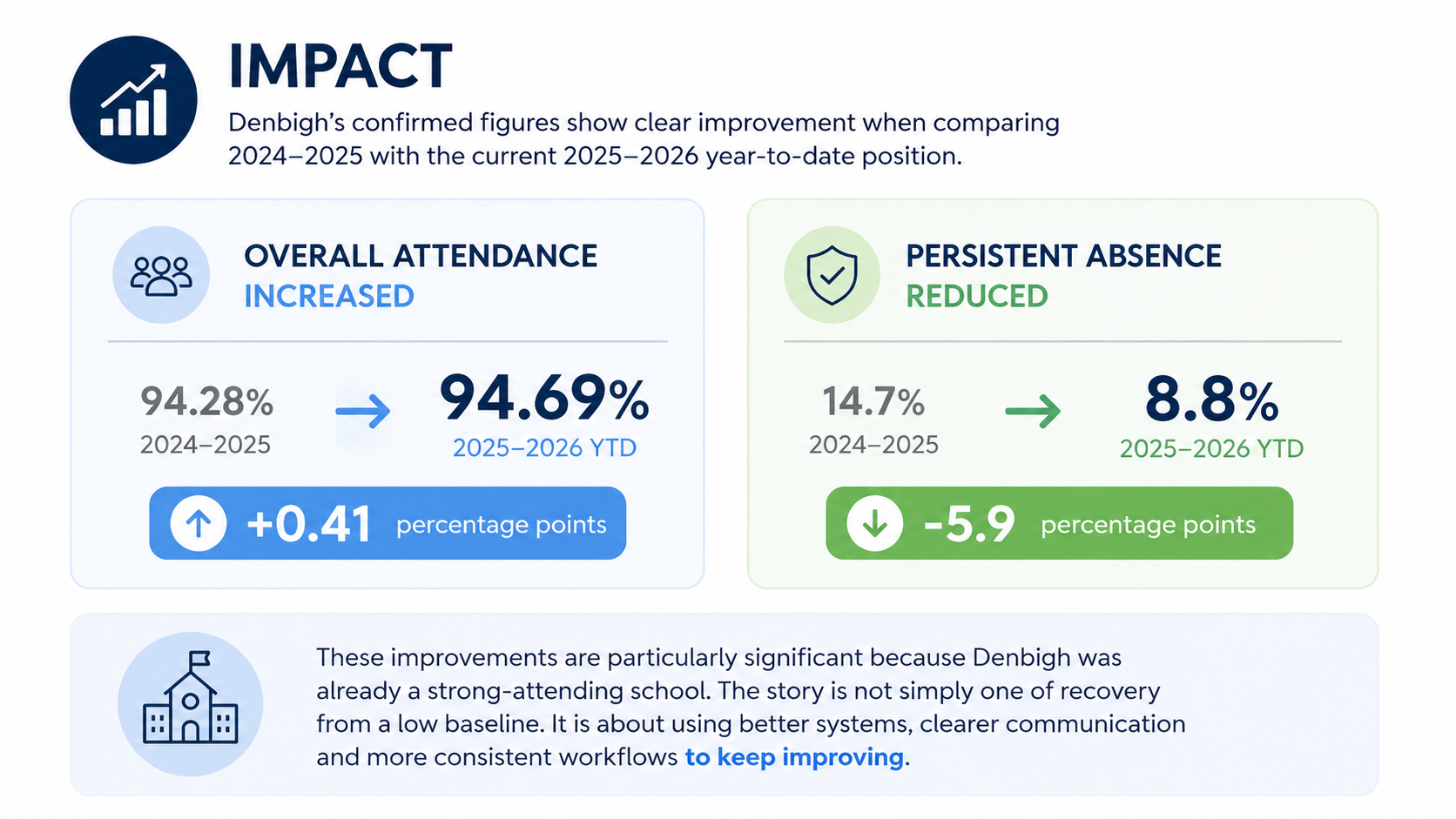
Denbigh’s confirmed figures show clear improvement when comparing 2024 to 2025 with the current 2025 to 2026 year-to-date position.
A more strategic approach
Attend has strengthened leadership oversight at Denbigh. Attendance is discussed regularly at SLT level, with leaders able to review live information and understand where action is needed. This supports a more systematic approach, helping the school evidence that attendance concerns are identified, tracked and followed up as part of an embedded cycle of review, communication and intervention.
The support from the Attend team has also helped Denbigh refine its use of the system. The onboarding process was described as supportive and responsive, with the school able to ask questions, shape set-up and make full use of the platform.
“Our Attend Partner through the onboarding process was very supportive and very understanding.”
Why this matters for strong-attending schools
Denbigh’s story is especially relevant for schools that already have good attendance and may feel they do not need additional support.
Attend is not only for schools facing serious attendance difficulties. It can also help strong schools go further by making better use of time, improving consistency, identifying risk earlier and strengthening the link between data, communication and action.
Denbigh School shows how an already successful school can use Attend to move attendance practice forward. Their journey demonstrates that attendance improvement is not only about responding to problems. It is about building a systematic, proactive and whole-school approach that helps every student belong, attend and succeed.
Click here to read the full case study.
See how Attend can support your school
Attend helps schools see attendance more clearly, reduce manual workload and act earlier when patterns begin to emerge.
Book a demonstration or contact the team to find out how Attend could support your attendance strategy.